

The Logic of Central Authority
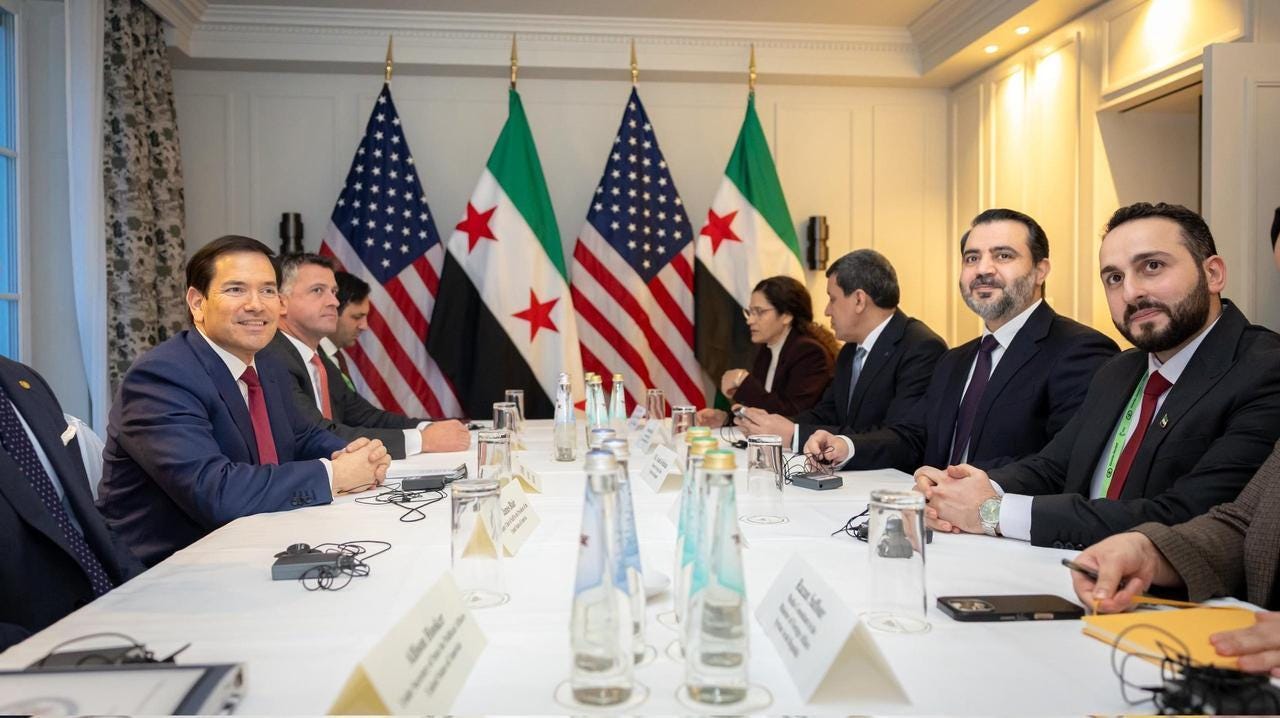
Damascus is close to achieving complete sovereignty over Syria for the first time since 2011. On 13th February 2026, SDF representatives Ilham Ahmed and Mazlum Abdi participated in the Munich Conference as guests under the auspices of the Syrian Foreign Minister, Asad Al-Shaibani.
Six weeks earlier, none of this was thinkable. The SDF controlled roughly a quarter of Syrian territory, including 90% of the country’s oil production, all major border crossings in Hasaka province with Iraq, and the camps and prisons holding tens of thousands of ISIS detainees. By early February, Damascus had exercised, or was in the process of assuming, authority over virtually all of it.
The al-Hol camp (transferred 20th January), the al-Aqtan prison in Raqqa (22nd January), the Al-Yarubiya crossing with Iraq, the oil fields of Deir ez-Zor and Hasaka, and the provincial capitals of Raqqa and Deir ez-Zor themselves. The Shammar tribal militia, the Sanadid Force, defected from the SDF en masse. Arab tribal leaders across the Euphrates valley, who had waited a year to see which way the wind would blow, made their calculations and aligned with Damascus.
On 3rd February 2026, approximately 120 of Syria’s Ministry of Interior (”MOI”) personnel entered Qamishli, the de facto capital of the PKK-aligned Autonomous Administration of North and East Syria (”AANES”, with their military wing known as the Syrian Democratic Forces, or “SDF”), and established a position at the city’s former Ba’ath Party headquarters. Three days later, a senior Defence Ministry delegation led by the commander of Military Security, Ali Al-Hassan, and Army Chief of Staff Major General Hamza Al-Hamidi travelled to Hasaka city for face-to-face meetings with SDF leaders. The Ministry described the talks as “positive” and announced that “specific timeframes” had been agreed for SDF withdrawal from civilian areas, joint coordination on removing barricades, and accelerating the military, security, and civilian integration process.
On 9th February, government officials visited the Rumaylan oil field (Syria’s largest) to discuss its handover to the Syrian Petroleum Company, with the Deputy CEO Walid al-Yousef confirming that oil field employees would have their salaries increased and none would be dismissed. That same day, the MOI’s Internal Security commander for Aleppo, Colonel Mohammed Abdulghani, convened a joint meeting of MOI and “Asayish” security officials in ‘Ayn Al-Arab (”Kobani”) to begin “unifying security structures and strengthening the pillars of stability in the region.”
What had taken the SDF years to accumulate in terms of territory, resources, and institutional infrastructure (not to mention the extensive tunnel systems they had built) collapsed in days when the accumulated failures of the SDF to build a social contract with the majority Arab population of the northeast proved weaker than the pull of the central state in Damascus.
In January, Damascus combined military pressure with political inducements such as Presidential Decree No. 13 on 16th January which granted citizenship to Kurds who had been left stateless by Ba’ath-era “reforms”, recognised Kurdish as a “national language,” and designated the Kurdish holiday, Nowruz, as a national holiday – eroding the SDF’s claim to legitimacy as the sole protector of the Kurds in Syria. US Special Envoy Thomas Barrack, who visited Damascus on 10th and 18th January, facilitated the ceasefire and integration framework, with the recalcitrant leader of the SDF, Mazlum Abdi, practically compelled to comply.
On 9th February, when Foreign Minister Asad Al-Shaibani and General Intelligence Service (”GIS”) chief Hussein Al-Salama represented Syria at the Global Coalition to Defeat ISIS conference in Riyadh, the Coalition’s joint statement welcomed “the Government of Syria’s stated intention to assume national leadership of counter-ISIS efforts” and admitted Syria as the Coalition’s 90th member. The SDF’s external raison d’être was as Washington’s indispensable partner against ISIS, and that has now been formally transferred to Damascus.
The insistence on central authority is the organising principle of everything Damascus has done since December 2024. Syria’s reconstruction costs and the need for a broad regional investment plan for Syria have been discussed in our previous report. None of this is achievable without a consolidated state that serves as a single legal authority across all Syrian territory, guaranteeing enforceable contracts, transparent dispute resolution, and certainty of property rights, among other prerequisites for FDI. Perhaps Gulf sovereign wealth funds can absorb political risk that private institutional investors cannot, but even sovereign capital requires confidence that the counterparty will exist in a recognisable form over the long term. A Syria with contested internal borders, competing armed factions controlling oil fields, and parallel administrative structures governing a quarter of the population cannot offer that confidence.
Central authority, however, need not mean centralised governance in all domains. The 18th January integration agreement with the SDF stipulated that government forces would not enter Kurdish-majority areas, leaving local police-type forces in command of security. SDF leader Mazlum Abdi was offered the right to submit candidates for deputy Defence Minister, Governor of Hasaka, parliamentary members, and senior civil servants. On 9th February, Abdi stated publicly that all “AANES” civilian employees would remain in their positions as part of the integration process, and that staff at the Semalka crossing into Iraqi Kurdistan would stay in their roles while government entities oversaw passport inspections, customs duties, and related sovereign functions.
The integration of northeast Syria under the control of Damascus is the most successful step that the central government has achieved thus far in building the scaffolding of a political settlement: a political bargain broad enough to generate domestic stability and international legitimacy, yet coherent enough to pursue the state-building that Syria’s reconstruction demands. This report examines how that settlement is being constructed, who sits at its core, how the coalition is expanding outward, and whether it can evolve from a stabilisation pact into a developmental coalition capable of rebuilding Syria.
The Core: Who Governs Syria
At the centre of Syria’s political settlement sits a small group that has expanded from the “council of five” at the heart of the Syrian government that Vizier analysed early last year. President Ahmad Al-Sharaa remains the centre of this order. The Constitutional Declaration signed on 13th March 2025 formalised executive supremacy (at least for the transitional period, though it is likely to continue beyond that): the president appoints all ministers, one-third of parliament, and all Constitutional Court members; no impeachment mechanism exists; legislative override requires a two-thirds majority that the president’s appointees can block.
Critical portfolios remain in trusted hands. Ali Keda, Deputy Secretary-General for Cabinet Affairs, was most recently observed hosting the Catholic Church’s leadership in Syria at the General Secretariat on 4th February 2026 to discuss the status of Catholic schooling. FM Al-Shaibani continues to lead Syria’s diplomatic rehabilitation, which has seen numerous successes over the past year: the lifting of the former HTS‘ leadership’s UN terrorist designation, the permanent repeal of the Caesar sanctions by the US Congress, and recently the EU’s €620 million pledge for redevelopment across 2026-2027, announced during European Commission President von der Leyen’s visit last month to Damascus.
Defence Minister Murhaf Abu Qasra continues to lead the military integration process, absorbing former rivals into a force targeting 200,000 personnel. Interior Minister Anas Khattab is overseeing the reconstituted security apparatus, having dissolved Assad’s four intelligence branches and replaced them with a unified structure under his ministry. The General Intelligence Directorate is headed by Hussein Al-Salama, who reports directly to the presidency, and recently represented Syria alongside FM Al-Shaibani at the D-ISIS Coalition in Riyadh on 9th February.
Two additions to the inner circle deserve attention. Maher Al-Sharaa, the president’s eldest brother, serves as Secretary-General of the Presidency, a role without cabinet rank but with substantial informal authority as gatekeeper and enforcer. Hazem Al-Sharaa, also the president’s older brother, leads the economic committee overseeing asset transfers from co-opted business elites and a sovereign wealth fund announced in July 2025.
Beyond the inner circle, the 23-member cabinet sworn in on 29th March 2025 comprises core loyalists, technocratic outsiders, and minority representatives. Finance Minister Muhammad Yasser Barniyeh spent 15 years at the Arab Monetary Fund and has been in constant motion, meeting the IMF’s Middle East director, Jihad Azour, in Dubai on 3rd February, as well as the IFC and the French Development Agency in the same week. Economy Minister Muhammad Nidal Al-Shaar, a former professor at George Washington University, participated in the Fifth International Conference of the Saudi Centre for Commercial Arbitration on 4 February.
The concentration of power described above invites an obvious question for many observers: Is Syria building a dictatorship? The answer is more complex than the question implies.
The settlement retains features of authoritarian governance. Executive power is constitutionally unchecked during the transitional period. The security apparatus draws heavily from HTS’s Idlib infrastructure. The president’s family holds economic and gatekeeping roles. The People’s Assembly, elected in October 2025, comprises two-thirds of its members elected through electoral colleges and one-third appointed by the president, providing a forum for representation without threatening executive primacy. On 10th February, the Supreme Committee for People’s Council Elections held a meeting with the Governor of Raqqa to discuss preparations for holding elections in the governorate, which had recently come under government control.
But the coalition is structurally broader than a dictatorship. Minorities hold cabinet positions with operational responsibilities – not just cosmetic appointments. Tribal leaders have been steadily integrated and now have genuine stakes in the settlement. Business elites are being restructured. External patrons and powers, such as Türkiye, Saudi Arabia, the EU, and the US, are imposing constraints on the government’s behaviour through conditionality frameworks in exchange for sanctions relief and investment. The northeast integration framework accommodates Kurdish identity within a unitary state framework.
Thus, what is emerging is neither a democracy nor a conventional authoritarian state, but a hybrid form of governance constructing a power structure that concentrates strategic authority while distributing participation broadly enough to sustain stability in a country as diverse as Syria.
Expanding the Political Settlement
A political settlement held together only by the inner circle’s patronage is no more than a junta that replicates the worst aspects of Syria’s pre-war political economy. What distinguishes the Syrian project is its systematic outward expansion: it incorporates tribes, co-opts business elites, engages minorities, demands local autonomy, integrates rival factions such as the SDF, and secures regional patrons such as Saudi Arabia and Türkiye.
Tribal incorporation has been consequential for Damascus’ efforts to consolidate control over northeastern Syria. The government established a dedicated Office of Tribes and Clans, with Abu Ahmed Zakour serving as the presidency’s tribal advisor. Sheikh Nawaf Al-Bashir’s realignment in December 2025 brought the largest tribal confederation in the Euphrates valley, the Baggara, into the government’s orbit. The ‘Uqaydat and Bu Sha’aban confederations are embedded in military and administrative structures in Deir ez-Zor. The Shammar’s Sanadid Force defected from the SDF during the January offensive. These relationships proved decisive when tribal defections delivered the bulk of SDF-held Arab territory within 48 hours after the offensive commenced.
Business elites have been restructured through negotiated surrenders that break the Assad-era pattern of autonomous crony fiefdoms. Controversially, Mohammad Hamsho announced on 6th January 2026 that he had signed a “comprehensive” agreement with the government, transferring approximately 80% of his commercial holdings (estimated at $800 million or more). Rami Makhlouf, who once controlled an estimated 60% of Syria’s economy, fled to Moscow and has been excluded. At least in this case, Damascus has consciously chosen to pursue the path of least resistance in recouping much of Syria’s looted wealth, with the trade-off being that fully pursuing transitional justice would be unlikely to yield either the trial (and imprisonment) of Assad-era crony businessmen or the smooth seizure of much of their capital.
The treatment of minorities is where the settlement’s inclusionary claims face the most scrutiny. The Kurdish question is being addressed through the integration framework described above, guaranteeing citizenship, linguistic recognition, cultural rights, and administrative accommodation at the local level. On 4th February, the Deputy Governor of Aleppo, Ali Hanura, hosted Arab and Kurdish civil society figures from ‘Ayn Al-Arab to discuss service priorities; on 9 February, senior Kurdish National Council (”KNC”) official Bashar Amin described a meeting with Al-Sharaa as “positive,” adding that the president had “affirmed that the rights of the Kurds are protected and will be enshrined in the country’s constitution.” It is entirely possible that any post-SDF Kurdish political faction that emerges will be co-opted by Al-Sharaa as a key ally of Damascus. Al-Sharaa seeks a broad enough tent to counter-balance any other faction from achieving too much dominance as part of the president’s objective of state-building.
Suwayda remains the outlier, the only province in Syria outside Damascus's control. The Druze-majority governorate has maintained de facto autonomy under Hikmat Al-Hijri’s unified National Guard, disproportionately composed of Assad-era militiamen and officers. Damascus’s approach has been patient containment rather than military imposition, as Suwayda accounts for 3% of Syria’s population within a geographically confined area. Economic pressure will continue to accumulate on Al-Hijri, whose integration of Assad-era militiamen and officers into his forces has turned the province into the last holdout of Assad-era smuggling and corruption. Additionally, Damascus is cultivating ties with prominent figures of the Druze community as a counterweight to Al-Hijri’s dominance, and time will tell if the same settlement reached in the northeast can be reached in Suwayda.
These are crucial developments in Damascus’ drive towards a political settlement in Syria. However, while a political settlement can stabilise a country, it does not necessarily translate into development. This distinction is consequential for understanding the long-term trajectory of Syria’s redevelopment and is largely absent from analyses of the country's emerging power landscape. While institutions are necessary for development, they are not sufficient; what matters is the political coalition that underwrites national stability and unites around the objective of development, thereby building and sustaining those institutions. Development takes off only when a poor country’s elites back it, shifting from protecting their own positions to gambling on a growth-based future. A political settlement in which too many actors extract rents from the bargain can produce stability without prosperity. Thus, a developmental coalition is a specific form of elite bargain in which growth becomes the shared project.
From Settlement to Developmental Coalition
A political settlement can hold a country together; only a developmental coalition can rebuild one. The distinction matters because Syria’s trajectory over the next decade depends on which of these Damascus actually constructs. A settlement distributes enough power, revenue, and recognition across key actors to prevent any of them from defecting. It is, at its core, a stability pact. A developmental coalition is something more demanding: an elite bargain in which the major stakeholders collectively wager on growth rather than extraction, accepting short-term constraints on their own rent-seeking in exchange for a share of a larger future economy. The history of post-war reconstruction is littered with settlements that stabilised countries without developing them. In neighbouring Lebanon, after the Ta’if Agreement, confessional elites carved the state into extractive fiefdoms that have produced four decades of stagnation punctuated by collapse.
The cases where devastated countries achieved transformative growth share a common architecture. In post-war Japan, the Liberal Democratic Party fused landed conservatives, industrialists, and the state bureaucracy into a coalition whose internal competition was channelled through the Ministry of International Trade and Industry (MITI) into export-oriented industrial policy; factional rivalry persisted, but the factions competed over who could deliver faster growth in their constituencies rather than over who could extract more from a stagnant pie.
In Singapore, Lee Kuan Yew’s People’s Action Party subordinated every domestic interest, including labour, Chinese business clans, the Malay minority, and the civil service, to a growth strategy administered through the Economic Development Board, making national development the sole basis of regime legitimacy. In both cases, concentrated executive authority was the instrument, not the objective; what distinguished these developmental states from mere autocracies was that elite cohesion was organised around productive investment rather than patronage distribution.
Syria’s economic institutional scaffolding is taking shape, with the Syrian Investment Authority under Talal Al-Hilali and the Development Fund under Safwat Raslan, and shows some strategic direction, as evidenced by the structured Chevron MOU and the Tartus transactions, and by the Finance Ministry’s engagement with the IMF. The restructuring of Assad-era business elites through negotiated asset surrenders, rather than either wholesale expropriation or co-optation into new crony networks, suggests Damascus understands that a developmental coalition requires disciplined capital allocation, not the redistribution of spoils.
But intent is not outcome. Whether Syria builds a developmental coalition depends on whether the elites at its core, such as the military, tribal, commercial, and bureaucratic interests, are gambling on Syria’s future rather than extracting from its present. Ahmad Al-Sharaa, who has staked everything on reconstruction, appears to grasp this. The question is whether enough of the coalition around him does as well.